
Medical and Pharmaceutical applications – Sample Test kits
PIGGYBACK LABELS
Product Overview
Piggyback labels are produced as a multi-layer construction with adhesive on the bottom layers, creating a 2-in-1, multi-use label. The main label sticks directly on the first item and it’s top layer can then be removed, becoming a second label for a secondary use. The release liner within the main label that’s layered under the top layer’s (secondary label’s) adhesive can also be printed on if info needs to be displayed on the main label after the second label is removed, such as a barcode or return address.
Piggyback Label Applications
Piggyback labels are useful for a wide range of applications across many industries. Most people encounter piggyback labels without ever realizing they’re seeing or using a specialized label construction. You can see them being used on consumer items to display additional information about a product when surface space is limited, on shipping labels with detachable tracking or return labels, or in many barcode applications where a matching barcode or serial number needs to stay on the product but also be placed on a trackable service document.
TLP has used piggyback labeling in creative solutions for many customers. Most notably, for healthcare applications.
CHALLENGE: A healthcare provider needed a simple and reliable way for patients to easily label their test kit sample containers before returning them, while maintaining accuracy, minimizing labeling and human errors, and streamlining the testing process for the lab.
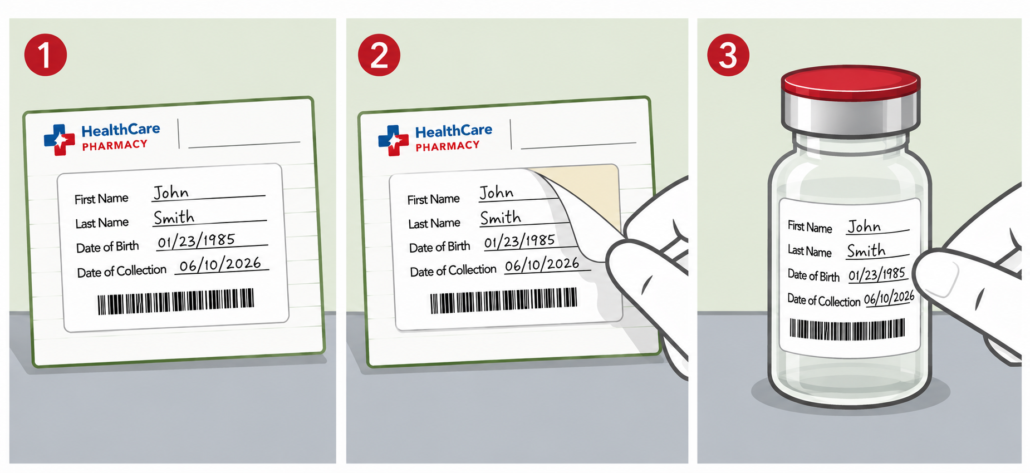
For this piggyback label design, TLP pre-prints the removable top layer of the label with the information a patient is required to fill out. When the healthcare provider is preparing the sample test kits to ship to their patients, they remove the label from the roll and place it on a card that is then included in the sample test kit. When the patients receive the kit, they fill out their information on the card, peel the secondary label off of the card, and place it on their sample container before shipping their sample over to the lab for testing. The lab receives their sample and has a standardized and uniform way of identifying the sample.
SOLUTION: TLP designed a custom piggyback label that is included on a card in the patient’s test kit that standardizes patient information capture and sample identification with a single, user-friendly two-layer label.
As a result, the process is easy and simple as all the patient needs to do is fill in the blanks on their card containing the label and adhere the label to their sample, ensuring that the info the lab receives is consistent with all other samples received and trackable back to the correct patient.
TLP’s piggyback label simplified the patient experience, reduced the number of labels required, improved sample identification, and streamlined the overall screening kit process. Piggyback labels are easy to produce and offer flexibility in design customization to fit many use-cases. If you have an application that requires more than one use for a label or multiple labels that could be simplified into one, ask one of our label engineers for ideas on how to improve the way you’re using your labels today.
Share this entry
Tailored Success
BENEFITS OF A CUSTOM PIGGYBACK LABEL SOLUTION
- Consolidation of multiple labeling functions into one label
- Simplified application for users
- Reduced risk of identification errors on products
- Improved traceability when using piggyback labels with barcodes or variable printing
- Reduced inventory and application time