
 Let’s Take a Closer Look at the GHS Label
 Let’s Take a Closer Look at the GHS Label
The Globally Harmonized System (GHS) of the classification and warnings on labels for chemicals is an international standard designed to ensure that the dangers of handling hazardous chemicals are understood by all participants in their manufacture, transportation, usage, and disposal.
GHS Labeling
According to the U.S. Occupational Safety and Health Administration (OSHA), the GHS labeling system is “a logical and comprehensive approach” to:
- Defining the health, physical, and environmental hazards of chemicals
- Creating classification processes that use available data on chemicals for comparison with the defined hazard criteria
- Communicating hazard information, as well as protective measures, on GHS label and Safety Data Sheets (SDS).
The Globally Harmonized System: Warnings Include Six Standardized Elements
The GHS label warns workers that a chemical container (such as a steel drum) contains a specific chemical that may be hazardous under certain circumstances.
The six elements on these warning labels, as detailed by the Environmental Protection Agency, are:
- Product identifiers: Names or numbers used on a hazardous product label or in a safety data sheet.
- Signal word: One word used to indicate the relative severity of the hazard: “Warning” for less severe hazards; and “Danger” for more severe hazard categories.
- GHS Pictogram(s): A symbol inside a diamond with a red border, denoting a particular hazard class.
- Hazard statement(s): Phrase assigned to each hazard category that describes the nature of the hazard.
- Precautionary statement(s): Phrases that describe recommended measures that should be taken to minimize or prevent adverse effects.
- Supplier identification: The name, address, and telephone number of the manufacturer or supplier.
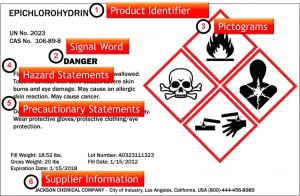
NiceLabel software , available from TLP, includes a powerful graphical label designer that allows business users to easily design GHS compliant label templates.
GHS Label Importance
In the United States, the chemical industry is a $673 billion enterprise, with $161 billion of that coming from exports, according to the American Chemistry Council. OSHA’s 2024 update to the Hazard Communication Standard, which aligns U.S. requirements with the seventh revision of the GHS, affects roughly 1.5 million workers across nearly 148,000 establishments.
In its most recent update to the Hazard Communication Standard, effective July 2024, OSHA estimates the GHS-aligned rule will save businesses a net $29.8 million per year, with reductions in chemical-related worker injuries, illnesses, and fatalities, according to the agency’s final rule.
TLP specializes in Warning and Safety Labels, which must meet rigorous third-party requirements. Contact us to see how TLP can assist you in meeting your safety labeling needs.
Topics Covered
What is GHS labeling? Inside the Globally Harmonized System
GHS Label